
Kaleido Intelligence Report · April 2026
Navigating the Roaming Market Transition in 2026
The global roaming market is at a decisive inflection point. 5G Standalone is maturing, VoLTE has become a baseline expectation, and travel eSIM providers are reshaping competition. Quality is now the currency.
By SEGRON & Kaleido Intelligence
13-minute read
Published April 2026
$35B+
Wholesale roaming revenues forecast by 2030
370+
5G networks live globally as of 2026
277
Operators with live VoLTE roaming in 126 markets
90+
Operators already running 5G Standalone
Traditional voice & SMS revenues set to fall
70% by 2030 as data takes centre stage
A New Phase for Global Roaming
In 2026, roaming has clearly entered a new phase. The expansion of 5G roaming, continued VoLTE migration, and the steady move towards 5G Standalone (SA) are reshaping how services are delivered. Standalone networks unlock capabilities such as network slicing, enhanced security, and more granular service differentiation — capabilities that were simply not possible under the Non-Standalone (NSA) architecture that most operators still rely on today.
This shift is not purely technical. It is deeply tied to how roaming is monetised. Traditional voice and data models are giving way to more dynamic patterns: travel eSIM providers, enterprise use cases, IoT endpoints, and application-specific services. At the same time, a major structural change is underway in how wholesale partners are selected — moving from lowest cost-per-megabyte to a Quality-based Wholesale model, where verified service performance determines partner preference.
Operators must ensure consistent performance across highly diverse network environments. By focusing on Quality of Experience (QoE), roaming is transformed from a supporting function into a scalable revenue engine that reflects the real-time value provided to the end-user.
Five Trends Defining the Market
1. VoLTE Roaming Becomes Non-Negotiable
With legacy 2G and 3G networks retiring globally, VoLTE roaming is no longer optional — it is the critical layer for reliable voice service. As of Q1 2026, around 277 operators across 126 markets have launched VoLTE roaming. However, many still have limited bilateral agreements, and in several markets LTE coverage exists without inbound VoLTE roaming, highlighting a clear gap between deployment and assurance.
The stakes are rising sharply. The removal of 2G/3G eliminates all fallback options, making every VoLTE failure more visible and commercially damaging. VoLTE testing is also a prerequisite for 5G Standalone — which will not support legacy fallback under any circumstance.
2. 5G SA Roaming: Progress, But Caution Prevails
Over 370 networks have launched 5G globally, with more than 90 operators already running Standalone and many more shifting to cloud-native architectures. Yet 5G roaming today largely still relies on NSA, providing broad global coverage across 200+ operators in 131 markets. The transition to SA represents a structural transformation — replacing legacy Diameter signalling with HTTP/2-based protocols and introducing a service-based, cloud-native interconnect framework.
- 56% of operators cite lack of scalable revenue models as the primary barrier to SA roaming adoption
- Most operators remain in testing and evaluation phases, working out how to monetise capabilities like network slicing
- The first real wave of SA roaming traffic is expected from enterprise-driven use cases, low-latency services, and enhanced broadband
- Security is redefined under SA: SEPP frameworks become mandatory for encrypted, authenticated signalling between networks
3. Travel eSIMs Reimagining Roaming Competition
The rise of travel eSIM providers is accelerating both diversification and competitive pressure across the roaming ecosystem. According to Kaleido's 2025 Wholesale Roaming Survey, 61% of operators now view travel eSIMs as a commercial challenge, as new entrants compete aggressively on pricing, flexibility, and user experience.
For operators, the picture is mixed. Travel eSIM growth creates a direct threat to retail roaming revenues, but simultaneously opens a wholesale opportunity — inbound eSIM traffic is expected to become a significant revenue driver. The critical challenge is assurance: any failure during profile provisioning or initial network attachment results in immediate customer frustration and high churn rates.
Top Commercial Challenges for Wholesale Roaming (2025)
Expanding coverage for new services (VoLTE, 5G)69%
Growth in local & travel eSIM providers61%
Lack of 5G SA roaming use cases56%
Roaming quality of service55%
Negotiating new commercial models for IoT48%
Source: Kaleido Intelligence Operator Survey 2025
4. The Quality-Value Commercial Model
Traditional wholesale pricing — anchored to the lowest cost-per-megabyte — is struggling to accommodate modern roaming behaviours. A major shift is occurring toward a Quality-based Wholesale approach, where traffic steering is optimised based on verified service quality (throughput and latency) rather than cost alone. Preferred partners are selected based on a combination of competitive rates and independently verified high-quality service throughput.
"Wholesale roaming revenues for MNOs are expected to exceed $35 billion by 2030. Traditional pillars like voice and SMS are set to decline by more than 70% between 2025 and 2030, while data-driven services take centre stage."
Kaleido Intelligence, April 20265. Real-Time QoS Becomes a Business Priority
With consumer behaviour shifting toward streaming and latency-sensitive applications, Quality of Service is no longer a technical metric — it is a business priority. 20% of operators now view real-time quality management as the single most important innovation area in roaming. Studies by OpenSignal, Ookla, and SEGRON have shown that roaming users are frequently steered away from 5G, spend more time on legacy networks or Wi-Fi, and experience materially worse latency and lower download speeds than local users.
From Testing to Service Assurance
The roaming testing market is entering a more demanding phase. Operators are under pressure to modernise roaming capabilities while maintaining service quality, billing accuracy, and security across a more complex traffic mix. The core driver is the transition away from legacy networks toward LTE, VoLTE, and 5G environments — but that is only part of the story.
Demand for roaming assurance is rising because customer expectations are rising. Consumers now expect the same quality of voice and data services abroad as they receive at home. Yet there is a clear gap between strategic priorities and actual investment: VoLTE roaming, 5G roaming, charging evolution, and service assurance are widely recognised as important, yet only a minority of operators plan to invest materially.
73%
Prioritise roaming analytics and real-time quality management
72%
Prioritise VoLTE roaming service testing and commercial deployment
50%
Prioritise 5G Standalone roaming service testing and/or trials
Source: Kaleido Intelligence Operator Survey 2025 — Top technical requirements being prioritised within roaming business units.
The path forward is proactive service assurance rather than reactive testing. By evolving from event-driven verification to continuous, automated monitoring across live networks, operators can bridge the Quality Gap — and turn technical requirements into a genuine competitive advantage.
How SEGRON Closes the Quality Gap
SEGRON, founded in 2012 and headquartered in Amsterdam with its technology centre in Bratislava, provides automated active service assurance and monitoring solutions designed to validate roaming performance across the full service lifecycle. The defining characteristic of SEGRON's approach is real-device service assurance — using commercial smartphones to replicate actual subscriber behaviour rather than relying on simulated traffic or probe-based measurements.
Automated Testing Framework (ATF) & Global Service Enabler (GSE)
At the core of SEGRON's portfolio are two platforms. The Global Service Enabler (GSE) is a fully managed, hosted global service that utilises real smartphones deployed across more than 100 countries to provide immediate visibility into global roaming performance. It supports both SIM and eSIM validation and generates detailed KPIs for voice, video, data, messaging, and OTT services. Using Layer 3 trace analysis and deep packet inspection, GSE enables detailed validation of advanced services like VoLTE and 5G — validating application-level performance that probe-based systems simply cannot detect.
A key differentiator is SEGRON's ability to detect issues such as roaming steering misalignment, delayed session establishment, and service degradation that would otherwise go unnoticed in traditional testing environments. The platform also supports charging and tariff validation through session-level data generation, ensuring billing accuracy in complex roaming environments.
- End-to-end roaming service assurance across 4G, VoLTE, and 5G NSA/SA on real commercial devices
- Continuous monitoring and pre-launch validation — reducing time to market while protecting service quality
- SIM and eSIM validation including full profile lifecycle: activation, provisioning, network attachment
- Charging and billing accuracy verification through session-level data generation
- Global footprint scaling beyond 150 countries with cloud-based managed service model
eSIM Validation: The First-Minute Experience
The competitive success of travel eSIM providers — and the host operators that enable them — hinges entirely on the first-minute experience. Any failure during profile provisioning or initial network attachment results in immediate customer frustration and high churn. SEGRON's GSE addresses this with a unified workflow that automates the validation of the entire eSIM lifecycle: from profile creation through secure delivery, network attachment, and live session verification on real, unrooted smartphones deployed in key international corridors.
This proactive approach provides the high-performance visibility required to turn the complexity of eSIM into a scalable, reliable revenue stream — rather than a source of customer support incidents.
Proactive Assurance as a Strategic Advantage
The real issue is not lack of demand for service assurance — it is a gap between recognised importance and actual investment. Operators who close this gap by automating processes, reducing costs, and demonstrating clear business value will be the ones who turn roaming into a scalable competitive advantage.
Book a Demo- Real-device testing across 120+ countries — replicating actual subscriber behaviour
- Continuous monitoring from lab validation through to live network assurance
- Full eSIM lifecycle validation — profile delivery, network attachment, session quality
- VoLTE and 5G NSA/SA testing with Layer 3 trace analysis and deep packet inspection
- Charging, billing accuracy, and IoT roaming validation in a single managed platform
Full Report
Download the full roaming market report
Complete the form and receive access to the Kaleido Intelligence reprint licensed for SEGRON.
Loading form...

Testlabs
Measuring HD Voice+ Calls over Bluetooth LE Audio
SEGRON measured HD Voice+ (EVS super-wideband) calls over Bluetooth LE Audio on live VoLTE networks, with POLQA scores up to 4.55 MOS-LQO.
October 7, 2026

News
Real Devices, Real Answers: SEGRON at MVNO Nation Europe 2026
Join SEGRON at MVNO Nation Europe 2026 in Alicante to see how real-device testing is redefining service quality for MVNOs. Meet Michael Sedlacek and Markus Zimmermann and discover how SEGRON’s platform proves QoE, QoS, and eSIM performance the way your customers actually experience it. Book a meeting with us and turn network quality into your competitive edge!
September 29, 2026
News
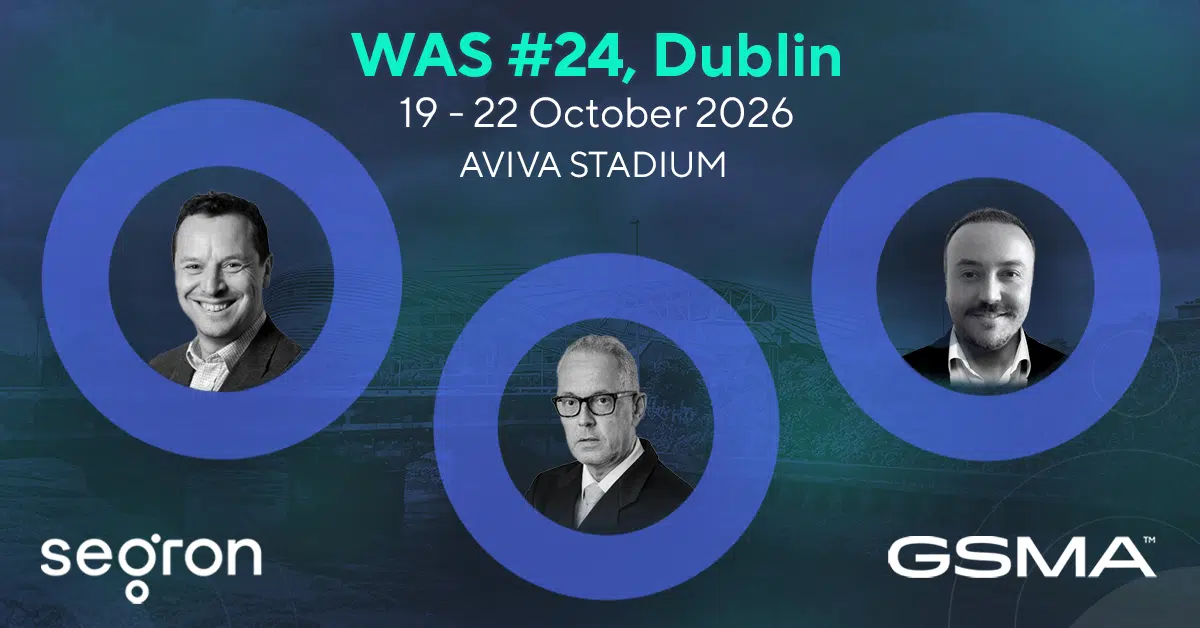
Let’s talk QoE at WAS#24 with SEGRON
Join us at GSMA WAS#24 in Dublin to explore the next generation of active testing and roaming innovation. Meet our team and see how SEGRON’s advanced platform is shaping the future of QoE, QoS, and network automation. Book a meeting with us and stay ahead in the evolving world of digital connectivity!
September 29, 2026

