

Measuring HD Voice+ Calls over Bluetooth LE Audio
- Reading Time: 4 minutes
More and more calls now run through earbuds, headsets and car kits. If the Bluetooth link carries only wideband audio, that is what the listener hears, however good the network codec is. Until now, it was also all our test setup could hear.
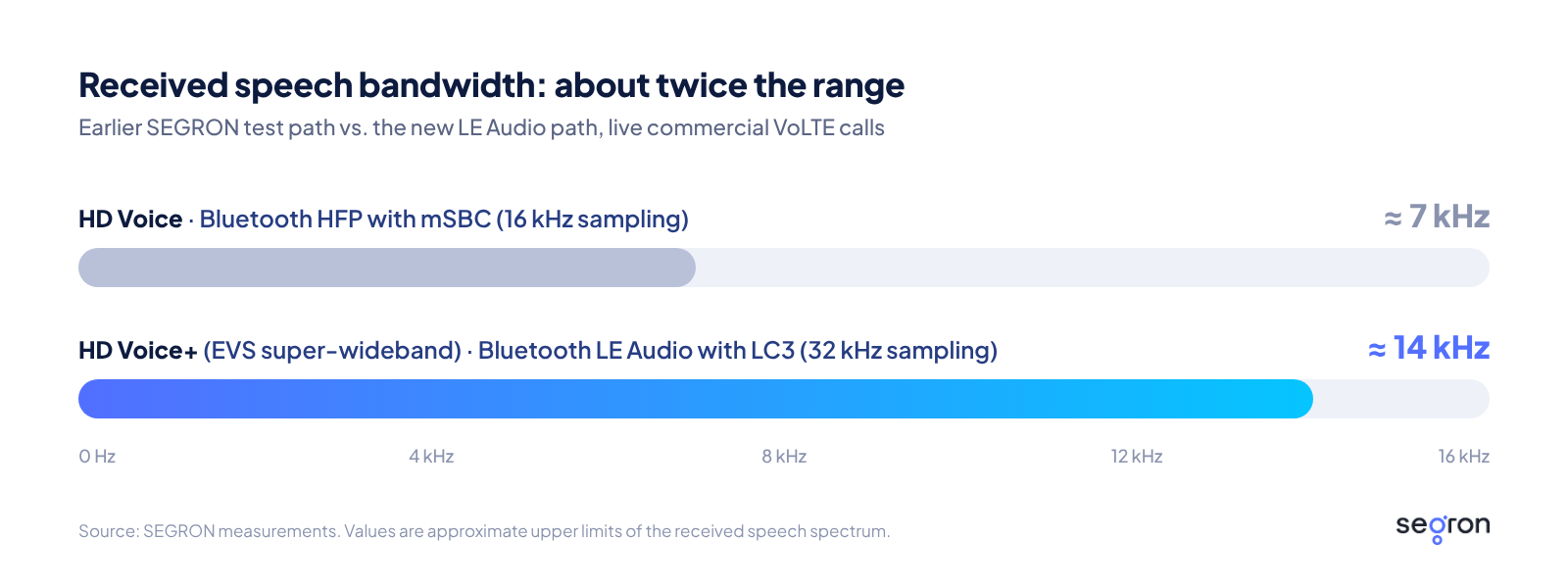
SEGRON has now measured super-wideband (SWB) voice quality over Bluetooth LE Audio on live commercial VoLTE calls, with POLQA scores up to 4.55 MOS-LQO. In our previous article on HD Voice over Bluetooth, the received audio reached approximately 7 kHz. This proof of concept extends that range to around 14 kHz, allowing us to assess the additional speech detail that HD Voice+ can deliver.
What HD Voice+ adds
GSMA HD Voice+ uses the Enhanced Voice Services (EVS) codec to support richer, more natural speech. In super-wideband mode, it carries roughly twice the audio frequency range of traditional HD Voice.
Why the Bluetooth path matters
Our earlier setup used the Bluetooth Hands-Free Profile (HFP) with mSBC. Its 16 kHz sampling rate limits useful speech content to around 7 kHz. Even if the mobile call carries super-wideband audio, that path cannot preserve the full range for measurement.
For this proof of concept, we used Bluetooth LE Audio with the LC3 codec at 32 kHz sampling. The phones, Bluetooth adapters and host software must all support the required LE Audio features. A Bluetooth version number alone does not confirm that the call uses them.
The 7 kHz limit applies to our previous mSBC path. Newer HFP implementations can also support super-wideband speech; LE Audio is the approach validated here.
How SEGRON tested live calls
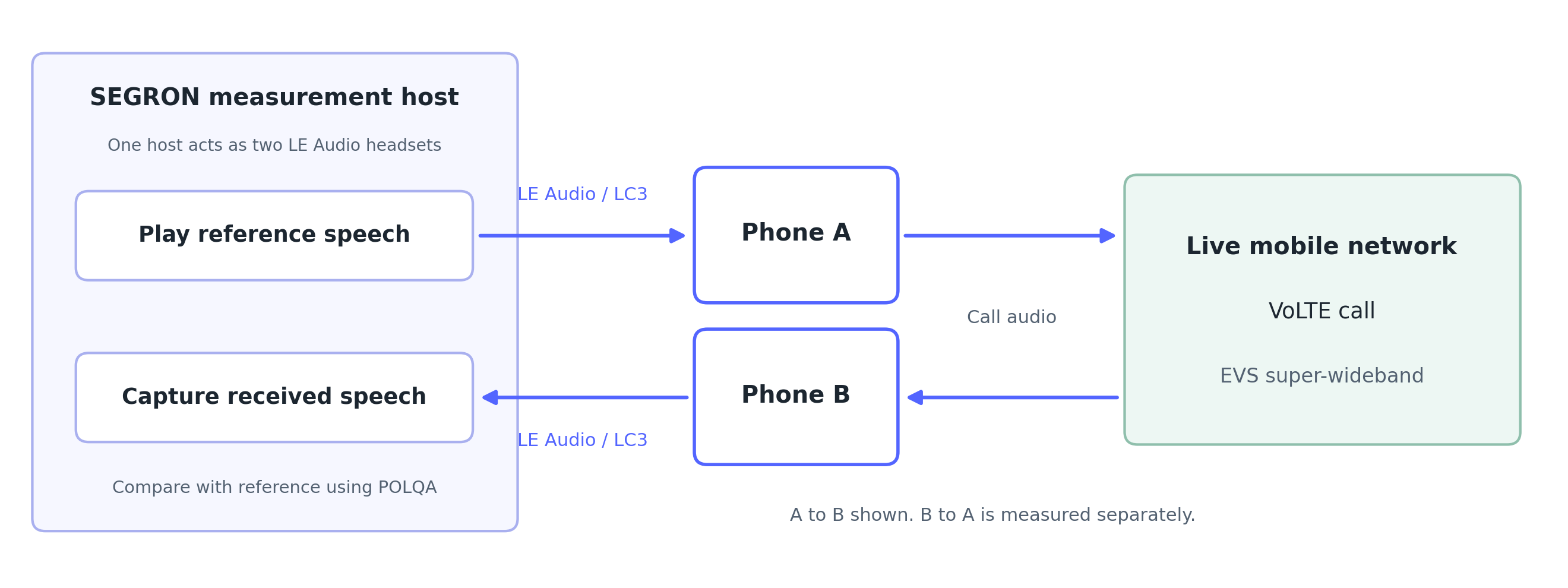
Two smartphones were connected through a live commercial 4G network. Each phone was paired to the same SEGRON measurement host through its own Bluetooth LE Audio adapter. The host acted as a headset for each phone, playing reference speech into one and capturing the audio received by the other.
We verified EVS super-wideband in the handset service menu during the call. Both Bluetooth links used LC3 with 32 kHz sampling, 10 ms frames and mono audio. A separate check confirmed that the audio path depended on an established mobile call.
Voice quality testing without enhancing the recording
We compared an eight-second ITU-T P.501 super-wideband speech sample with the received recording using POLQA (ITU-T P.863). Its MOS-LQO score is an objective prediction of listening quality: a higher score indicates better perceived speech quality.
We also checked the measurement setup itself. The host transmit path scored 4.7525 MOS-LQO, compared with 4.7960 for the reference evaluated against itself: a difference of about 0.04 MOS-LQO for this part of the setup in the tested configuration.
Super-wideband reaches the analyser
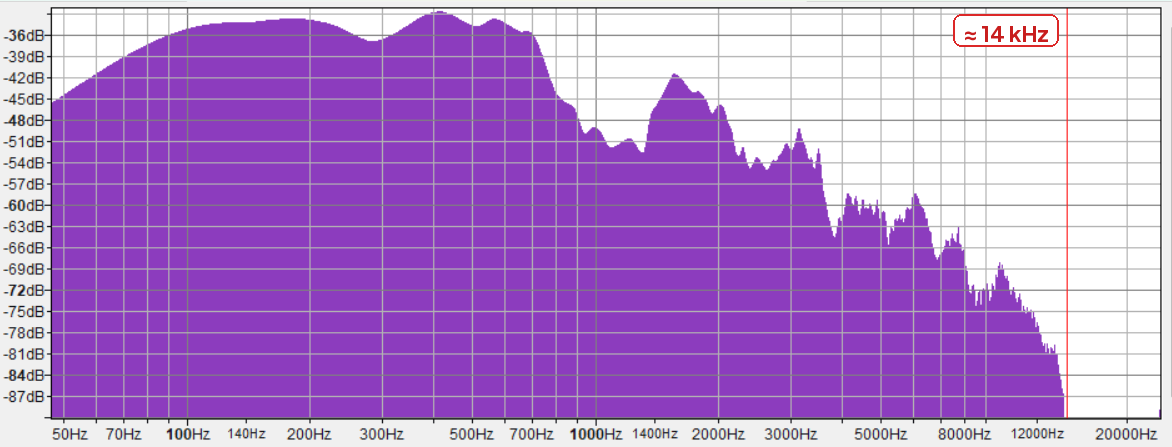
The received spectrum extends to around 14 kHz, beyond the approximately 7 kHz limit of our earlier mSBC setup. Together with the handset codec checks, this supports the presence of super-wideband audio through the tested path. POLQA then evaluates the listening quality of that audio.
What the live measurements showed
We ran five campaigns across Samsung Galaxy S24, S25 and S26 handsets on two commercial networks. Each campaign included five measurements in each direction, giving 50 measurements in total. Results were kept separate for each direction.
The best live-call result reached 4.55 MOS-LQO, compared with 4.80 for the reference sample evaluated against itself. At the same time, the measurements showed noticeable variation depending on the handset combination and call direction.
This is the practical lesson: HD Voice+ quality cannot be assumed from a single device pair or one call direction. Reliable assessment requires testing both directions across multiple device and network combinations.
Bringing HD Voice+ into automated testing
For operators and device teams, the benefit is a measurement path that preserves super-wideband speech for assessment. This can support validation of HD Voice+ services and investigation of quality differences across device and network combinations.
These digital audio measurements complement the acoustic tests needed to assess the complete listening experience in a headset or vehicle.
The proof of concept is complete, and we are now working to integrate this capability into SEGRON’s Automated Testing Framework (ATF). Contact our team to discuss HD Voice+ testing, or meet us at WAS#24 in Dublin, 19–22 October 2026.
Categories
Tags
Frantisek Valent
Recent Posts
Interested in our Products ?